
Date added: 09/08/2025
Lessons of Stone

The still-fresh impressions of creative work with stone, condensed into three lessons. Reflections gleaned from the sculpture workshops led by Ms. Anna Wszyndybył at the Polish Sculpture Center in Orońsko.
There’s a place in Poland where Mutants lazily graze in the square in front of the Palace. In the park, you can get lost in a labyrinth, guided by the whispers of angels, and nestled among the trees is a giant egg with a loudly beating heart. Here, burnt matches are at least 4 meters long, and the hoofprints of invisible horses can be seen on the ground. Here, you can stroll endlessly, discovering further nooks and crannies of the artists’ collective imagination…
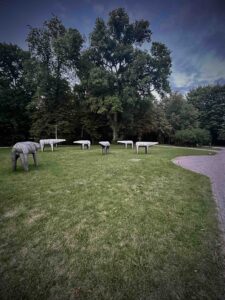
Mutants, Magdalena Abakanowicz, 2000 – fot. AMN
spent the last week of July at the Polish Sculpture Centre in Orońsko, where I not only walked in the park, but above all I was carried away by the spirit of this place – undisturbed creative work.
As a participant in this year’s sculpture workshops at the Center of Polish Sculpture, I had the opportunity to enhance my skills and try my hand at stone carving. The week-long workshops were led by the outstanding sculptor and sculpting instructor Anna Wszyndybył. Anna supported and guided the work of a group of about a dozen people, helping each person navigate the process of working on their individual projects. At the same time, she shared her extensive knowledge and experience as a sculptor, which was a huge asset to this meeting.
Thanks to the Center’s excellent organizational support, we were able to enjoy accommodations and meals at the on-site hotel, and the staff working on the premises daily assisted us with every logistical and design challenge we encountered. This support system allowed for a truly unique work environment and focus on the task at hand. For a few days, I was able to free myself from everyday distractions and, for the first time in a long time, immerse myself in a single topic.
Intense contact with the nearly meter-high limestone gave me a real workout, but it also opened up space for building a very unusual relationship. From these experiences, I’ve selected three “stone lessons,” which I’ll try to outline here. It’s a good moment, when I still feel the pressure in my hand from holding the hammer handle, and as the days pass since my return, I increasingly long to dance around and with the stone.
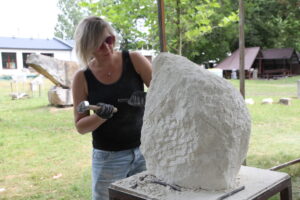
fot. Jacenty Matys
What does Johnny Bravo have to do with sculpture?
“Learn the nature of pebble, Johnny.”
In the next scene, we see Johnny sitting with his pebble and having a beer and continuing his monologue, he says:
“What are you talking about, man, girls go for rocks…”
536
Lesson One: See What You See
What did Johnny see in his pebble? Was everything happening in his head, and was he using the stone to drown out his loneliness? Or perhaps, from Johnny’s perspective, the stone, with its back to the viewer, had something resembling a tiny face? That could explain a lot.
It turns out that the phenomenon of seeing familiar shapes—faces, bodies, figures, or animals—in the forms assumed by nature has a name. It’s “pareidolia” (from the Greek), which can be translated literally as “beside the image” or “beside the form.” The name captures the essence of this phenomenon, because the person looking at a form—for example, clouds, rocks, trees, smoke—realizes that what they see in it is not real. It’s something “beside” the real form. This isn’t a deceptive illusion; it’s the form itself that triggers us and reminds us of a familiar pattern or image. What’s important is that we realize this. In this sense, Johnny probably went a step too far in his familiarity with stone.
I first began to wonder about “near-forms” during a trip to Iceland. What potential there is for exploring the nature of stone! I remember being filled with awe when, in the rays of sunlight and through the haze of morning mist, the island of Heimaey emerged—an island known for its volcanic formation, “Elephant Rock.” Completely unreal!
As is often the case in such magical places, there are many traditional stories and beliefs surrounding the rock. Usually, the simplest answers are the most accurate, so I’d wager it’s a giant elephant that fell asleep and turned into a rock. It turns out, however, that there are those who believe the elephant is a work of art and human work. Supposedly, it was carved as a monument honoring local island traditions. On this topic, an active volcano, periodically flooding the island with fiery and highly formative lava, seems… undecided. I wonder if anyone would find human work in the Tatra Sleeping Knight? What kind of hands would those be!
And so, incidentally, after this lengthy introduction, the first lesson from the stone appears:
“See, what you see”
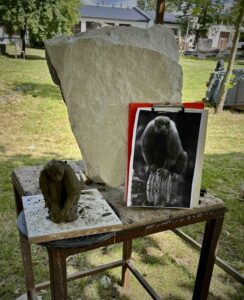
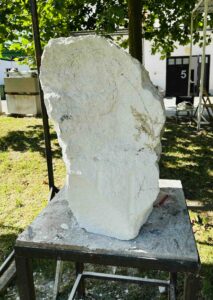
We arrived at the workshop in Orońsko already with ideas. On the first day, a tour of smaller and larger pieces of cut limestone gave us the opportunity to choose the stone we would work with. We received continuous support and advice from Anna, but the final choice was ours. Equipped with drawings or small clay models, we checked whether the shape, shape, size, and texture held the potential to enhance our images.
825
Lesson 2: Stone primes quickly
Creative work can evoke associations of ease or creative flow. Rarely are the first associations physical exhaustion, frustration, and gnashing of teeth, dropping everything and getting up the next day with a wavering hope to try again. Where are the creative workshop offers that promote investment in the charm of slow, incremental progress, in moments of doubt, and in limiting experiences when your sculpture suddenly loses its nose?
And the lack of experience in handling stone hurts. Everything hurt, everything hurts. My hands, wrists, and every finger, right down to the tip, were the first to feel the pain. There were moments, especially at the end of the day, when lifting the hammer and chisel again proved to be quite a feat. My knees and hips ached from climbing and descending the platform, and my head, heated by the sun, wouldn’t let me forget about it. I looked at the sculptures in the park, recalled the works of art I knew, the huge ancient stone statues, and in disbelief I asked myself – how?!
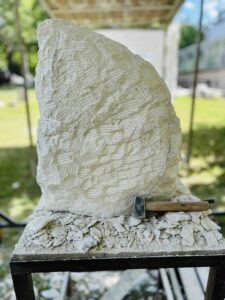
It turns out that it’s not force, but precision and consistency, that earns your stone’s trust. I discovered this during a consultation with our teacher, Anna Wszyndybył. In her hands, the chisel gently pryed the chosen spot and pulled only as much as needed to achieve the shape. In my hands, initially, the chisel or hailstone (a new word!) would randomly dig into the stone, slip, or tear off large fragments, and the hammer would dislocate my entire wrist so much that by evening I couldn’t even lift a fork to my mouth. Day by day, however, like Johnny Bravo sorting letters, I learned how to maneuver the tools and adjust my body position to avoid unnecessary strain. I think I was quite proficient at it by the end of the workshop, but as I say – pain, pain, pain of creation… but now I can proudly say I’ve unlocked the first level of the “subtle power of the forging hand” skill. Intensive work on the sculpture also meant that theorizing and intellectual processing of my project took a backseat. It’s not that they ceased to matter, but it’s difficult to simultaneously contemplate the fate of the world and sneeze in limestone dust, occasionally dodging a sliver hurtling towards my eye. I returned to these thoughts during evening discussions, but during the hours of chiseling, polishing, and sketching on the stone’s surface, my doubts shrank (or perhaps even grew) into questions about the true shape hidden within the form. For days, I walked around white as a miller, in sneakers stiff with dust, and with hair thick with dust. For seven days, this was my only reality, and I’m not afraid to admit that I haven’t rested this well in a long time. Doing my own thing and accepting it as it is.
The stone didn’t crush me, but it pulled me closer to the ground.
Lesson 3: Soft Stone Determination
Lesson three – the shortest, but also the most important. After all, the artistic layer of the creative process and its results cannot be ignored. If working with stone were a function of choosing the right shape and the artist’s technical experience, we wouldn’t have the enchanted park in Orońsko, we wouldn’t have the sculptural wonders of the world… because doesn’t a work extracted from stone (like any other material) still need some spark, an element of ambiguity, to come alive, to spark the imagination, and to speak to the audience?
During this week, I discovered that working with stone is quite complex. I thought following clay and its moods would be a challenge, but how I underestimated its harder cousin! One wrong move can send the work spiraling down a different path. At the same time, and perhaps surprisingly, the limestone we were working with was both hard and soft at the same time. This duality of nature meant that even if a failed hammer blow or a lost shell caused a significant dent in the sculpture, a new perspective emerged, waiting to be explored. It was as if the stone offered the opportunity to complete the project as planned until it suddenly changed its mind. Then it slowed the carver’s progress, pointing in a more suitable direction. As I peeled back the layers, I discovered the outline of the sculpture, but it was the gentle movements of the file after the mistakes that revealed the truth about the nature of the creature hidden within.
Working this way, I began to understand what our instructor, Anna Wszyndybył, meant when she said that if a sculpture exists in stone, it will reveal itself. A broken nose or a disproportionately protruding paw don’t mean it’s over; I drop it and go find a new stone. Absolutely. This is the moment when the stone speaks to me and directs my subsequent decisions. It expects me to look more carefully.
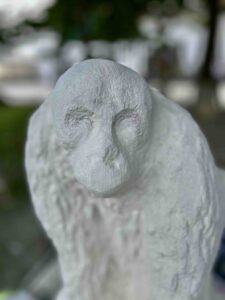
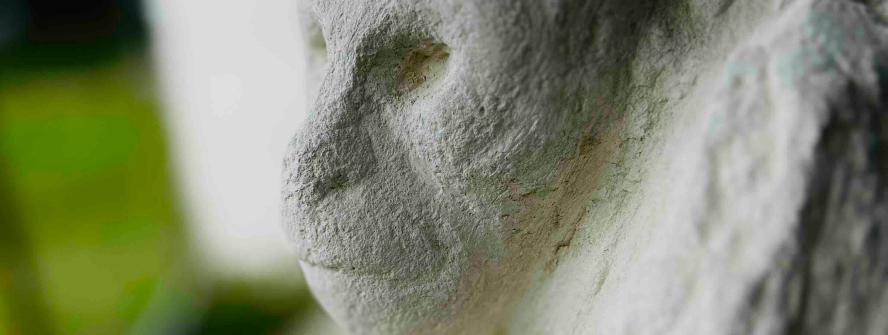
Uakari Stone Monkey
After a week of work, a monkey poked its head and overgrown fur out of the stone. The monkey, by any measure, turned out to be tiny. Research is ongoing, but I dare say I’ve discovered a new species of uakari – the European Giant Uakari.
This species is characterized by a friendly disposition. It interacts easily and enjoys cuddling. The discovery was unveiled, along with other discovered species of plants, animals, figures, and abstractions, during a small opening reception on the last day of the workshop.
See: Short video from exhibition opening
Who would have thought that the Monkey had been hidden inside the stone all this time? I think our Master, who always approached and offered advice at the right moment, knew this. I suspect the stone knew it too… but I, unsure of my first steps, had my doubts.
From now on, I will be observing stones much more closely to understand their nature. A small piece of marble from Ms. Ania is already waiting for my attention. I also expect that in time, when I’ve had a lot more practice, I will return to the studio and say, amused, to my stone friends, “Hey, you won’t believe what I wrote about you the other day!”
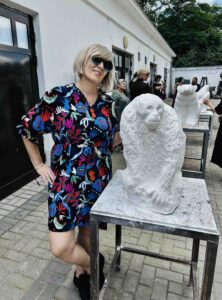
Uakari, stone sculpture, Agata M. Nowak – MORFIKA, Orońsko 2025