
Date added: 05/04/2026
Tranquilly

Walt Disney was once asked if it was difficult to create a cartoon, so popular today. He replied that it was a piece of cake; you just needed a good idea. However, he forgot to add that, in addition to a good idea, you also needed something as small as fifteen thousand drawings. The same applies to any sculpture, even something as small as a Japanese goose, a heron, a goat, or a guinea fowl.
(my own translation)
Magdalena Gross ( “Rzeźbiarki”, Dagmara Budzon-Szymańska, 2026)
One of the lessons I learned from working at the School of Crafts in Cieszyn and from last year’s meetings and open-air sculpture workshops was that regular practice yields results. It seems obvious, but it’s discussed and experienced differently. Such practice, enriched by contact with masters of the craft, their corrections, and many hours of independent practice, has opened up a completely new understanding of creative activity for me. Such practice, from the level of inspiration and emotional outpourings, can slowly bring you back down to earth. It turns out, for example, that the first idea isn’t always the best. Sometimes something can “come to fruition” by accident, but often the first concepts aren’t even good enough. The process of arriving at a satisfactory concept is ongoing, and this doesn’t diminish the artistic value at all. Although we don’t always consciously perceive it, initial intuitions are driven by deep analytical mechanisms. They can precede our decision to engage in conscious and creative analysis. They will also contribute to the knowledge-intensive, often arduous, workshop work. I’m slowly developing my own understanding of the creative process, based on my previous experiences and numerous conversations with artists. Practice and exercise allow me to reach places that intellectual processing alone can’t. Focusing too much on questions can become a trap, freezing me in the midst of emerging doubts. The point isn’t to have no doubts. That would be a trap. Rather, I’m aiming to regain balance in my creative pursuits, so as not to get stuck in deliberation or in the stage of eternal planning, but also to avoid spinning my wheels in impulsive creation.
I’d like to find some form of description, even a brief one, that captures this state of balanced exploration that broadens the horizons of understanding. “The golden mean” and “good enough” are phrases so devoid of meaning that I don’t see any use for them.
Recently, I’ve been deeply moved by a line from Albert Camus’s The Fall: “we’re only more or less in anything.”
More or less.
I like being in a creative situation only more or less. It doesn’t absolve me of responsibility, it doesn’t offer leniency, but it builds a realistic framework for decisions. There’s always some external “more” to aspire to, and some personal “less” worth understanding. We are always and only somewhere in between, in an unfinished process over which we have influence. If anything is close to the truth about human nature, I today believe in the existential “only more or less.”
***
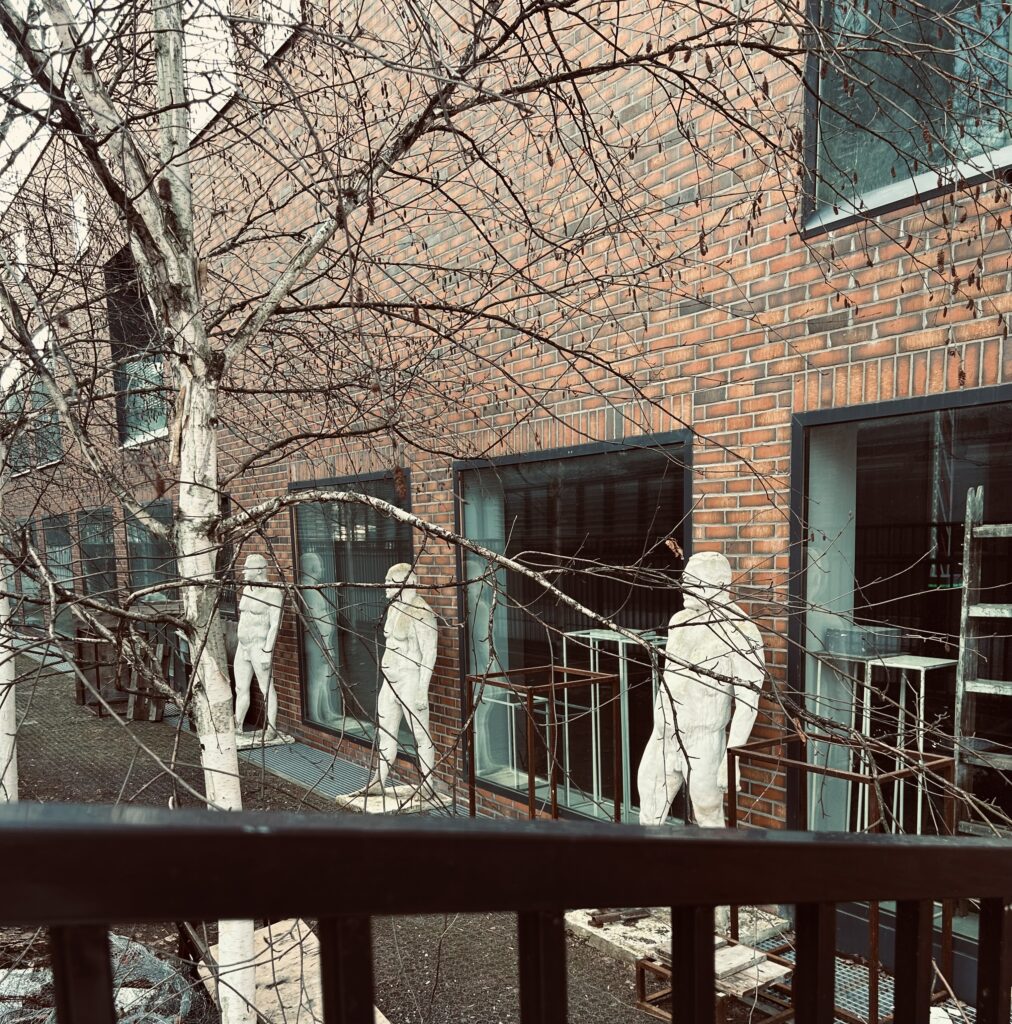
Academy of Fine Arts in Warsaw, Faculty of Sculpture – photo AMN, February 2026
Time flows at its own pace on Spokojna Street. The street itself, with its rather turbulent and difficult history, is now an absolute haven of peace and quiet in the very center of the city. The aura of the beautiful Powązki Cemetery and its greenery on one side, and on the other, the Media and Sculpture faculties, where many likenesses of the same naked man, cast in plaster, stand guard. Birds sing in the branches. The hustle and bustle of the busy city streets escapes here.
An atmosphere I didn’t expect, freezing on the train taking me to my first January class.
And it was you who felt my first breaths of active peace.
***
It was my dream to stand among a group of students surrounding a living person and watch them for hours, bringing out their character in clay.
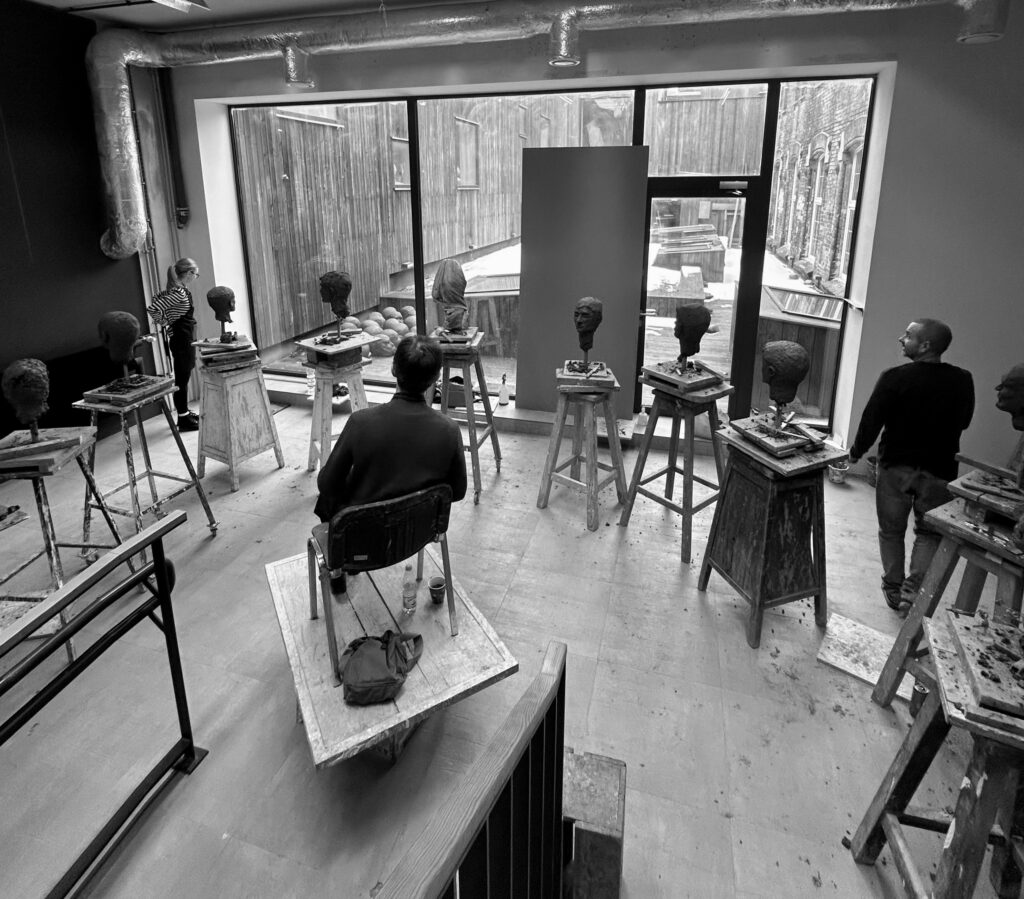
Captured during a sculpture course at the Academy of Fine Arts in Warsaw led by Mateusz Aftanas – photo AMN, February 2026
Observation is key. This is what Mateusz Aftanas, the sculptor leading our course at the Academy of Fine Arts in Warsaw, keeps reminding us. We relearn how to look, simultaneously forgetting our imaginations and memories of the head and face. How to observe shapes, shadows, refractions, widths… At times, I reach a point where the view of the posing person blurs, leaving only a collection of shapes.
Over the past few months, I’ve had the opportunity to study as many as four people this way. We’ll continue working on and casting the final portrait in plaster.
Each time (not counting breaks) after six hours of spinning the chess piece, adding and subtracting clay, getting close, even sneaking up on the model unexpectedly, or peering at them from a distance… each time, our work finally landed back in the large basin of clay. Nothing survived except the photograph. Sometimes, only an eye would peek out from inside the box for a while, as if it had a grudge.
Swept away, and back to the train.
Despite the undoubtedly hard work and effort expended, the loss doesn’t hurt as much when the focus shifts from the result to perfecting the craft. Each subsequent project comes together faster, more efficiently, more confidently, more fully, and more calmly.
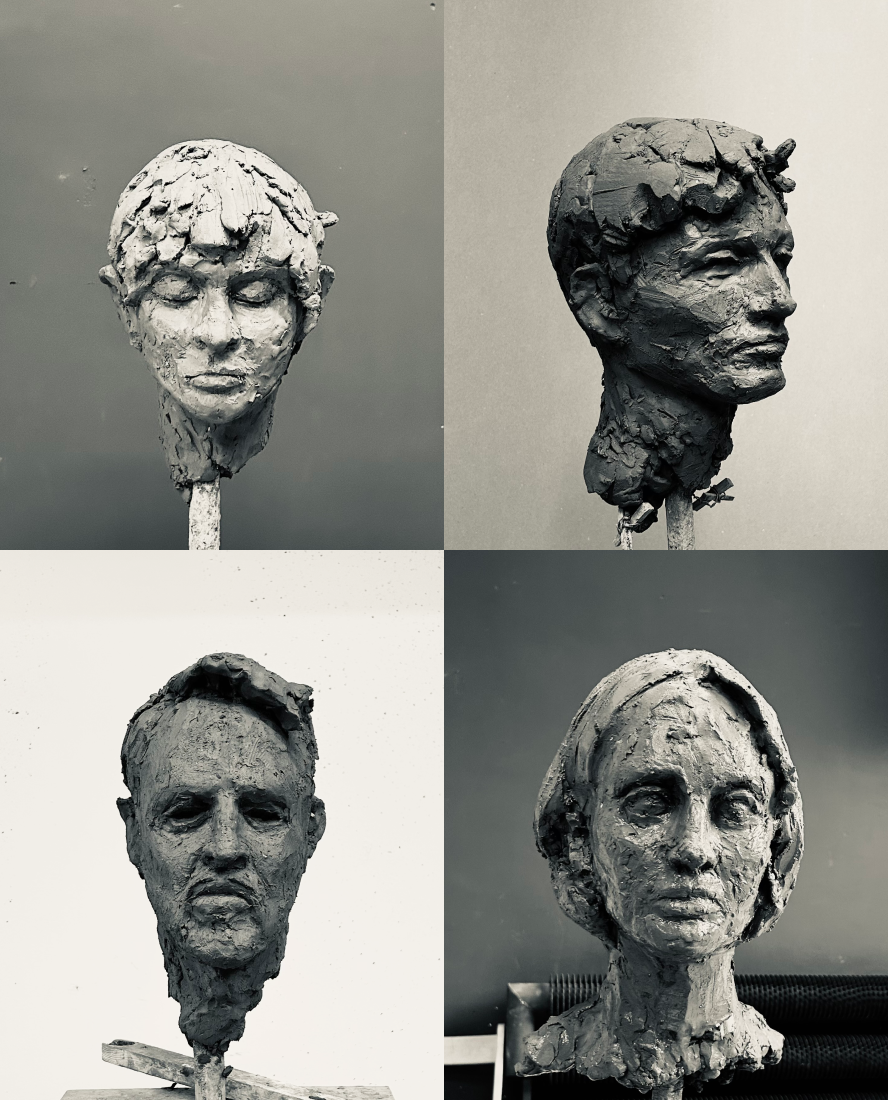
4 heads, each as the result of my work after a one-day course – photos AMN, 2026
***
Initially, I was worried that this was a laboratory situation, and that we usually don’t have access to the object of observation. What remains are sketches and photos, and a lot of imagination and memory, which can lead astray. However, in retrospect, I appreciate the opportunity to experience this and discover further steps for my own exercises even more.
I eagerly entered another area of study, this time “after hours”—the area of human and animal anatomy.
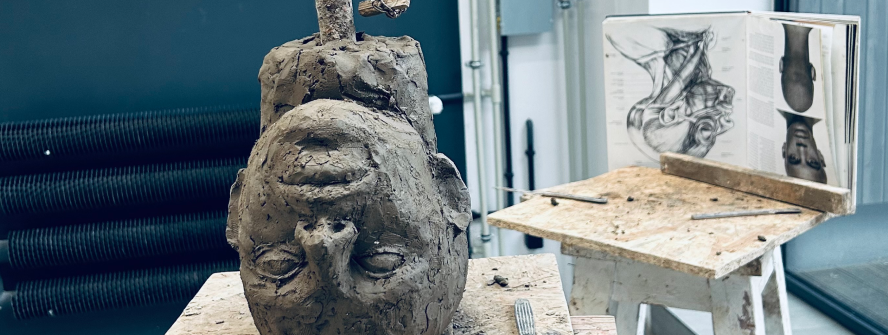
You have to manage. I began by analyzing and sketching using the album “Anatomy for Artists” by Sarah Simblet and John Davis. This magical book also helped me sketch a conceptual assignment—a response to the assigned theme, “The Mirror” (photo on the cover of this post).
My anatomical explorations led me to the work of Berlin-based sculptor Alexandra Slava. Alexandra specializes in classical, figurative sculpture. She is a graduate of the Florence School of Sculpture. In addition to her own artistic work and regular sculpture workshops held at the studio, she published a highly insightful online Masterclass on Portrait Sculpture last year.
In honor of my “more or less” choices, I decided this was an excellent start before considering international excursions and workshops in Berlin.
Alexandra Slava’s Masterclass is a very high-quality work and a great learning base. The video material contains over six hours of head study, rich in practical advice – working on a portrait with the model, Ms. Vladislava. The series of videos also includes a detailed section discussing the anatomy of the skull and facial details.
Following Alexandra’s step-by-step guide, I learned a slightly different, methodical approach to form building. When I sat down one Sunday to review the videos, with modeling clay and sketchbook at hand, I couldn’t put them down. Taking precise measurements and gradually adding mass—from profile to full shape—enriched observation and a sense of proportion with elements of a well-thought-out strategy. Despite sitting at the computer with a ball of modeling clay in hand, I was able to follow the instructor quite precisely. I was surprised by how methodically one could accelerate and organize the knowledge slowly gathered by the eye.
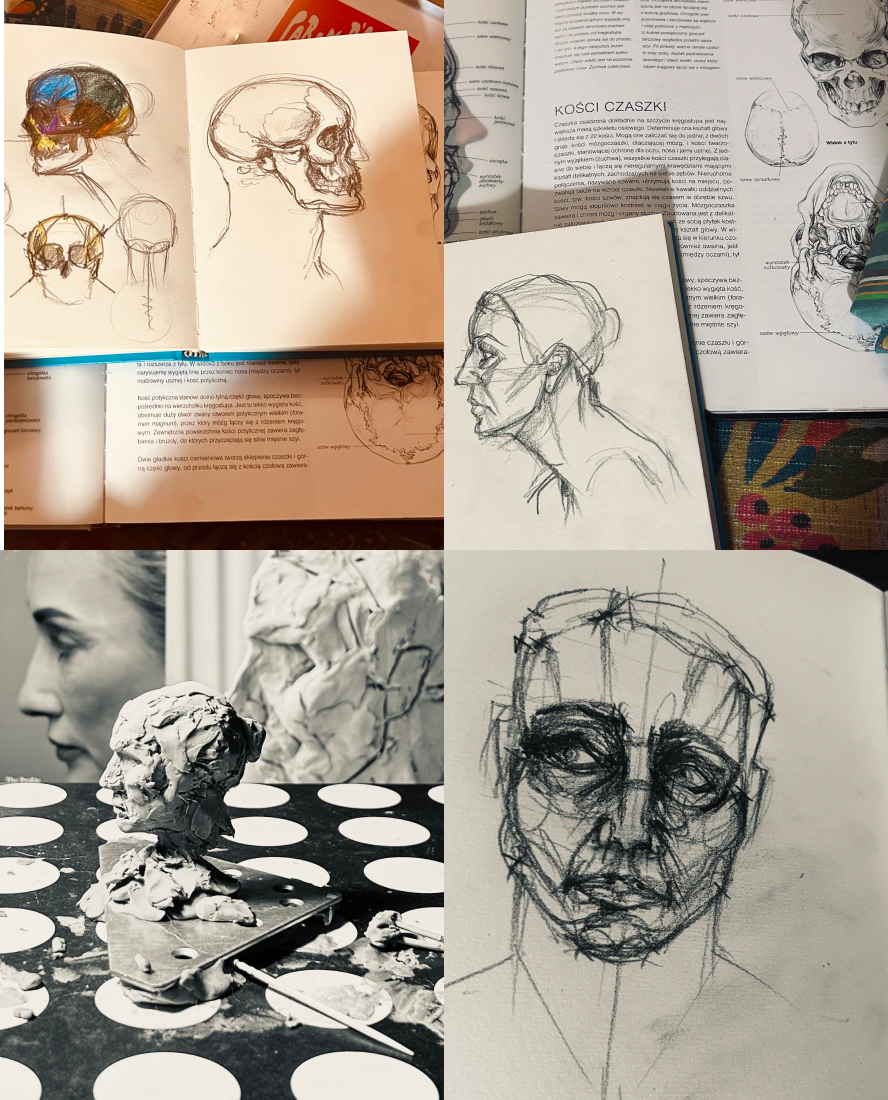
I plan to take a closer look at this on a 1:1 scale and find a “more or less” reference to it for my own work.
And here comes another breath of peace…
***
For a month now, I’ve been settling into my first studio of my own. I quickly gathered mostly used furniture, materials, and tools. With the support of friends, I set up a comfortable workspace for myself in a few weeks. When I started planning this significant change—moving my creative space from the City Workshop to my own space—I felt that now was the right time. The Ceramics Studio, which I co-run at the Workshop, is thriving. Since the beginning of the year, new people have been using this space and can build on what my colleagues and I have developed so far. Our regular Clay Encounters are going well, and they’ve even added sculpting exercises.
This is the right time to share my creative enthusiasm with the growing workshop community while also creating a space for myself for individual, focused work.
It’s a choice in the spirit of “more or less.”
When I enter my studio and close the door behind me, I’m filled with peace. I don’t have to rush anywhere; I can slowly study what I’ve planned.
I hang my inspirations on a magnetic board I saved from being thrown away.
Currently, portrait photos of Ms. Vladislawa, which Alexandra Slava shared in the additional materials from the Masterclass, await serious study. I’m calmly entering the next quarter.
And of course, I invite you to my place for tea.