Date added: 07/01/2026
Insight Frizbi

Is it possible to summarize the year by throwing a flying disc? In this article, I suggest that it’s possible and offer a ready-made object of cognition for you to test.
Introduction
Ten years ago, I took a picture of myself under a neon sign. I remember thinking it was so ironic at the time—I’d stand there and be who I described and defined myself as. It was a win-win situation.
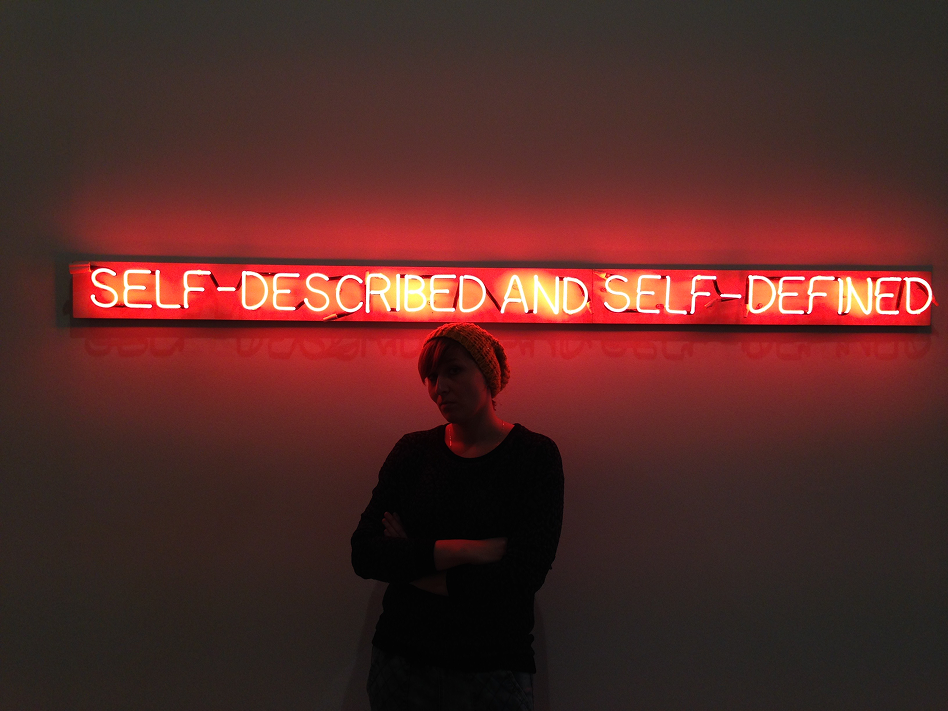
This neon sign is located in the Berardo Museum, a collection of contemporary art museums in Lisbon. It was created by Joseph Kosuth, the renowned American conceptual artist. From my visit to the museum, I took away this photo and the word “tautology.”
Last year, the theme of conceptualism returned to me during a contemporary art lecture, in the form of one and three chairs—a chair, a photo of that chair, and the dictionary definition of a chair.
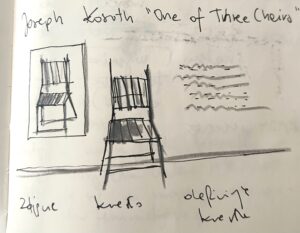
Lecture notes…with my mistake. The work is actually called “One and Three Chairs.”
The work was also authored by, as you might have guessed, Joseph Kosuth. Is this one and the same chair, or three different chairs? What is the relationship between the actual object and its visual and verbal interpretation?
In both works, the artist addresses the question of meaning. How are meanings assigned, who constructs them, how can we analyze them, how can we question them? Seeking and questioning the meanings imposed on us by prevailing narratives is an important role of art (I recommend a short interview). His neon designs are logical experiments – tautologies – expressions that are always true. These are artistic objects that speak for themselves. Words that “self-describe and self-define” are words that self-describe and self-define.
Can the object of knowledge be reduced to its description? Can an object describe itself?
Getting to know yourself and summarizing the year
A decade has passed since the photo under the neon sign. It’s the turn of 2025/2026, and I’m poring over my notes, preparing for a short exam. Participating in the University of Warsaw’s open courses in contemporary philosophy and contemporary art, taught by Dr. Olga Kłosiewicz, is one of the best decisions of the past year.
Everywhere I turn, I see publications, posts, broadcasts, discussions, top lists, and musical wraps for 2025… This is a time when, traditionally, but also entangled in commercial mechanisms, we look back on what has happened over the past 365 days. Furthermore, the first quarter of the 21st century is coming to an end. There’s enormous potential for analysis and comparison. What was this year like for the world? What was this year like for us? What were we like this year?
I’m starting to feel the need to join this growing wave of summaries and see my Morphic activity from a year’s perspective. But what should I choose? What format should I use? Top 10 most interesting events, Word of the Year, Photo of the Year, Projects of the Year, books read, The Year in Pictures, Lessons for the Next Year, a video compilation of the most beautiful moments…
As a reader, I read, watch, and listen to various summaries through the window of my phone. In many of them, I discover interesting information for myself and identify some that are distant from me. I appreciate the usefulness of this format and understand its popularity, but I also try to remember that such a quick impression and fragmented information can be misleading.
My reflections on the past year don’t easily fit into these social media templates. I don’t want to force them into them. Each of these simple forms requires choices, selections, and the application of some kind of filter. And I haven’t even decided what criteria are important? For whom and why is this year’s summary? What do I actually want to discover and what do I want to show?
I’ve decided that this year I’ll leave the fun and glamour of year-end reviews to social media and develop an alternative solution that I find satisfactory, and hopefully interesting for you. After all, I’m studying for a philosophy exam anyway, so why not creatively process this knowledge and ask myself a few questions? Let’s call it an optional term paper.
Object of cognition
The breakthrough and impetus for this project came from understanding the origins of the words “Subject” and “Object.” I conducted several in-depth interviews in my immediate surroundings to discover that this wasn’t obvious to me alone.
- Subject – from Latin SUBIECTUM, meaning what was thrown / positioned under, something fundamental
- Object – from Latin OBIECTUM, meaning what was thrown in front of, before one’s eyes
We throw something IN FRONT of ourselves that we are subjecting to cognition. The key is movement—the throw—and distance—the distance.
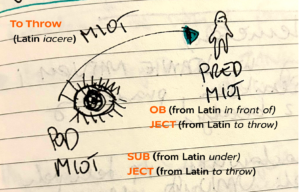
My drawing while listening to a lecture from the series “Philosophy of the Last Days” by Dr. Olga Kłosiewicz
Flinging, throwing, pushing are such bodily expressions that as I write about them, I feel them in my arms and shoulders. For a moment, I’m back in elementary school PE, serving on the Ringo court. Except that when we undertake self-cognition, we’re throwing something far more complex than a rubber hoop. We throw ourselves into the distance, so that from a distance, from the perspective of the “disengaged self,” we can discover the “disengaged self” being thrown before us. We are both the subject of the throw and the object being thrown in this situation. Can you see this in your mind’s eye? A fascinating image.
The ancient discus throwers might not have fully grasped this metaphor yet, despite Socrates’ efforts, because the powerful shift toward the human interior as the object of self-knowledge was initiated eight centuries later by St. Augustine. He introduced a “radically reflective” approach to his writings, through dialogue with himself and a first-person perspective.
The revelation associated with the symbolic throwing forward gave me the idea for my experimental canvas – a tool supporting self-discovery, which would contain “throwing” in its form and a question in its content.
And that’s not the only thing. I present to you…
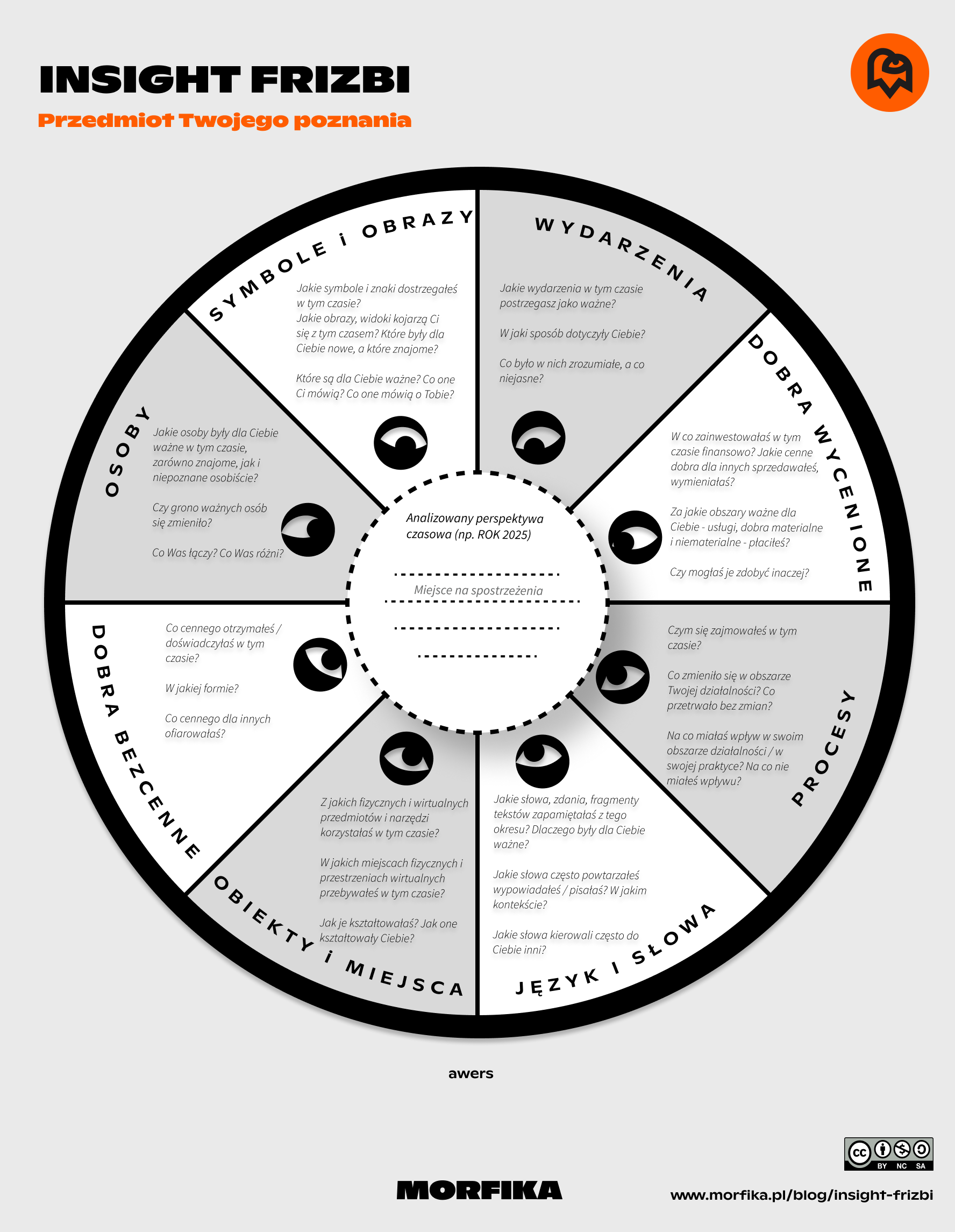
INSIGHT FRIZBI The object of your cognition
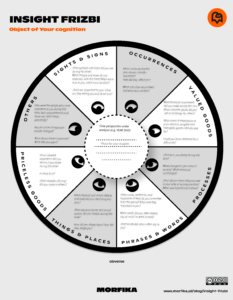
In short
What I am presenting to you in this entry is the first, prototype version of the Insight Frizbi canvas. The project will evolve as I gather feedback and develop my own reflection.
The idea behind the canvas is to stimulate the process of discovering new information about yourself by looking at yourself in a selected period of time. Insight Frizbi is an art project. Apart from its intended self-cognition purpose, it is primarily a trigger for reflection and discussion.
Taking Insight Frizbi in our hands – an object of cognition – we can imagine that we throw it backwards, where it lands uncatched. This may be a throwback to the past year, but it absolutely doesn’t have to be. We turn around and see an object in the distance, perhaps in the grass. As we approach it, we encounter various questions along the way.
Frizbi’s questions “at the top” were born in contact with selected contemporary philosophical concepts. I noted them in the margins of my lecture notes as interesting threads worth delving deeper into.
Why Frizbi?
The story of the Frisbee’s invention is surprisingly trivial and reveals something very symptomatic about the tendency toward self-description. In the late 1930s, inventor and entrepreneur Walter Frederick Morrison and his future wife were playing on the beach, throwing the metal lid of a popcorn can to each other. It must have been a blast, because a year later they were throwing a metal cookie cutter, which was heavier and more enjoyable to throw, to each other.
A curious observer offered the couple 25 cents to buy the cutter back. It wasn’t just a cutter anymore. It was a cutter with a proven excellent user experience—an object brimming with fun. Morrison immediately saw a potential business opportunity. Cutters without fun cost 5 cents. He could invest in them, optimizing the toy’s shape in the meantime…
This is how a legend is born. In the garage, or on the beach. Morrison’s Wikipedia history, however, makes no mention of the Friesbie Pie company, which had been producing cakes in metal molds since 1871, nor of the fact that playing with these molds had been familiar to students on campus for years. And this seems to be an important part of this story.
Today, few people are unfamiliar with the frisbee. It’s safe to say that the idea of the frisbee as a fun disc for throwing and catching has become deeply ingrained in the collective consciousness over the past 90 years. The choice of a “mold” for my experiment with an object of self-discovery is therefore not accidental. The familiar shape and context of use. Pleasant and safe associations with fun, lightness, and frolicking in the sand or grass all encourage one to try it. I’ve only allowed myself a small “typo” in the spelling. Frisbee is an object, but also the trademark of a throwing disc. Insight Frizbi is a circular diagram on a piece of paper where the “throw” is more symbolic than real. It’s a “glance” from different perspectives to gain insight.
How to work with Insight Frizbi?
Insight Frizbi is divided into 8 portions, like a very regular pie-chart. It is a set of interpenetrating 8 different perspectives converging at a central point of observation and conclusion.
We can start working with the canvas from any external piece. Each of them contains questions waiting for your observations. I do not suggest any order or method of completion. Of course, you can try to work methodically, clockwise. You can also rotate the Frizbi in all directions and refill it spontaneously. It is very likely that answers in one part will remind us of something to add in another. As in any game, apart from the basic rules, there is a lot of room for individual style.
The central circle cut out at the end is left as a space for summary and conclusion.
It’s worth taking a look at the little eyes inside. They are not there for decoration. They look across the central point, to the other side of the axis. They suggest that observations from one piece should be compared with other pieces. Ideally with everyone, but at least with the point of view opposite. Thanks to this, we can see something new and surprising, which in the form of our “insight” will appear stored in the center. And yet this is what Insight Frizbi is all about.
Remember that there is no limit on the number of answers to questions, and even less on the time to answer.
Insight Frizbi Perspectives
Occurrences – Things & Places

Occurrences and Things & Places are sections I’ve provisionally defined as the context of observation from a given moment in time.
Occurrences is a section in which we consider what was happening within our attention at that time and how we interacted with it. What I find very interesting is the extent to which events we deemed significant at a given time are perceived as relevant only to us, and how much they have significance in a broader perspective. Modernity has repeatedly demonstrated that events can be highly unpredictable and can surprise us unexpectedly. What do we understand about them, and how do we make sense of them? What fits within our system of understanding, and what is new and incomprehensible to us? How do we cope with this?
Inspiration: This piece is dedicated to the concept of the “metaphysical absence of meaning,” which I plan to explore in the future.
Things & Places is the section in which I pose questions about the physical and virtual spaces of our existence and functioning, in our chosen timeframe. The objects and tools we used during that time may be connected to places, but perhaps they won’t be characteristic of them at all? Interesting.
In the first draft of the canvas, I also added a question about places we haven’t been to. It’s not included here, but I encourage you to ask it yourself.
Inspirations:
The concept of posthumanism and the perspective of the human as a subject composed of human and non-human elements, what is naturally given and what is created. Humans as relational beings, entering into relationships with non-human entities through various technologies and interface overlays.
The concept of “non-place,” coined by Marc Augé, describes spaces where distinctive social relationships are not established and where there is little chance of developing a cultural identity. These are anonymous “waiting rooms,” like shopping malls or airports. Repetitive, but characterless. Reversing this vision, place can be defined as spaces that foster emotional bonds and identification.
Valued Goods and Priceless Goods

The next two segments of the circle together form a spectrum of acquired and experienced values—purchases, investments, gifts, exchanges, losses, and possessions. What do we value, and how did we experience these values during the analyzed period? What did we invest in, what did we share, what was shared with us? What did we give to ourselves?
Inspiration: American philosopher Michael Sendel’s critique of the free market. The thinker points to the growing phenomenon of the commodification of value, including the imposition of prices on important, universal, non-market social values such as care, compassion, and spirituality. One serious consequence of this process may be the development of a cynical attitude, one that “rationally” calculates the potential gains and losses in, for example, aid initiatives.
Sights & Signs – Phrases & Words

Pieces relevant to the area of communication—giving and receiving meaning. What important and/or recurring symbols and signs did we notice during this time and read them in some way? Were there any images or scenes that we retained in our memory as characteristic of this time? What do they communicate, what do you discover beneath them?
Phrases and Words, on the other side of the disc, is a look at our connection with ourselves and the world through language. Paraphrasing Wittgenstein’s classic that the limits of our language are the limits of our world, we can reflect on what we said, what we wrote during the period under analysis, and what we heard and read. What written content did we reach for, and what appeared around us? Perhaps we learned a new word, or changed a habit by using a trendy slogan? Perhaps we intentionally abandoned certain expressions, or had to adapt to the linguistic rules prevailing in our environment? How did words influence our behavior and decisions? Where did they appear?
Inspiration: Jurgen Habermas’s theory of communicative rationality, which argues that changes at the linguistic and communicative levels towards a rational exchange of arguments have transformative potential, offering the opportunity to create an egalitarian, just society.
Others and Processes

The last two pieces of Insight Frizbi correspond to an area I would describe as Relationships.
Processes involve experiencing one’s own actions in relation to the environment. They provide a space for reflection on actual activities and achievements during the analyzed period, but also on the possibilities and limits of one’s agency.
Others encompass questions about significant relationships with others at that time. Here, the questions touch on the immediacy and volatility of our relationships, but also on their durability and diversity.
Inspirations: Charles Taylor‘s critique of individualism, in which the thinker questions the contemporary enthusiasm for an attitude of unlimited self-development and the search for personal authenticity, confronting it with the importance of creating meaning on the basis of social cooperation.
Center
 Once you’ve filled in all the sections with your answers, you can follow the gaze of your little eyes. Notice if the answers from the opposing Frizbi particles share a common thread or engage in an interesting dialogue? Perhaps Symbols and Words will suddenly take on new meaning when put together? And how will the balance of purchased goods and priceless values be calculated? It’s also worth spinning the disc again, comparing your answers between the areas.
You might discover, for example, that people important to you played a significant role in events, or that a new work tool has influenced the way you think about your work. The
Center is a place for your insights, which will serve as a summary.
What doesn’t Frizbi specify?
When developing Insight Frizbi, I wanted to create a space for discovery, without the feeling of having to correct or change. Therefore, there are no questions about what worked and what didn’t, the pros and cons, what’s worth continuing and what’s worth abandoning. I thought of Frizbi as a board on which we record observations and examine them, seeking new information, insight—recognizing new knowledge about ourselves. It’s not about whether this past year was easy or difficult, nor about our successes or failures, but rather about who I see when I look back on my past year.
The second aspect, which I deliberately omitted, is questions related to the body, senses, and emotions. There are no questions about what you felt, what your body was telling you, etc. I considered this to be a different, more substantial level of analysis for the proposed areas. I leave it up to you how, and whether, you incorporate your observations of emotions and the body into your responses to Insight Frizbi. Absolutely every area described in this tool can be overlaid with additional questions about emotions and body experiences. Feel free to add them if you need them.
And finally…
I hope you’ve made it this far. The fun continues, and I have one more challenge for you.
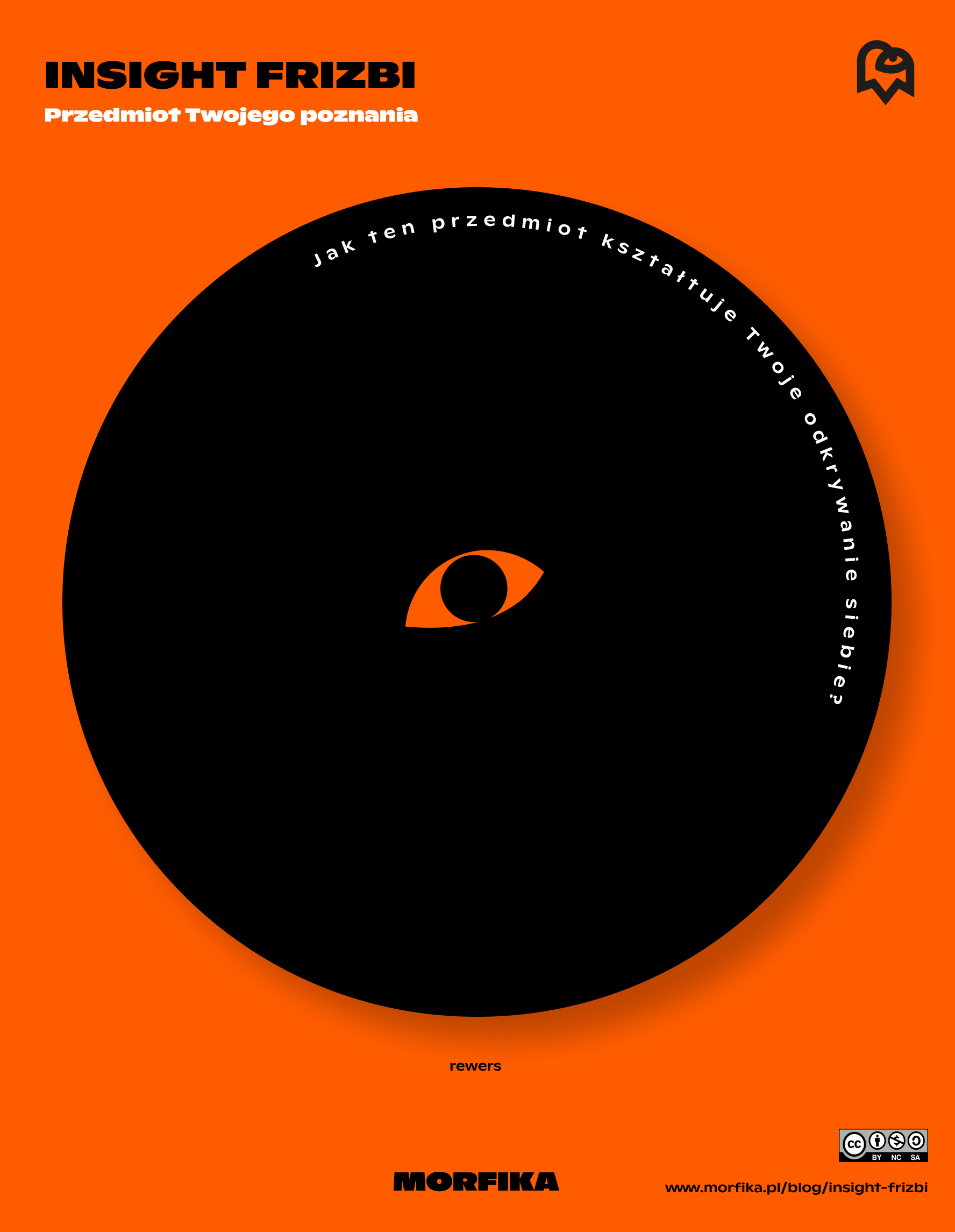
Once you’ve finished playing Insight Frizbi and created your summaries, flip the Frizbi over and throw it again.
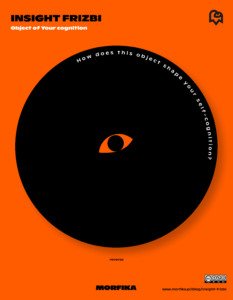
I wish you a lot of fun and, of course, a Happy New Year!
Tool usage
Insight Frizbi is a research and artistic project. Canvas is not a tool for commercial use. The current form is a prototype of the exercise, intended primarily for individual use. The project is open to suggestions for changes and improvements. I encourage you to share your feedback, ideas and questions. If you are interested, please contact me at agata@morfika.pl. I will send you the tool in PDF format. for testing.