
Date added: 17/07/2025
Which is the creature

This essay follows one possible path in searching for an answer to the riddle. New threads and meanings emerge as the project for the ART Mejking exhibition unfolds and through reflection on the changing city, inspired by the first Gliwice Art Biennale. Our guide, the cat, makes sure not to lose his way in the thicket of threads and digressions, although the rabbit he’s chasing encourages us to fall into the first hole we encounter.
Before the beginning
“What goes on four feet in the morning, two feet at noon, and three feet in the evening?”
Before I sit down to write properly, I fiddle with the search engine, playing for time a bit. The hardest part is getting started. Google, when asked, isn’t playing the same game as me. It responds quickly. “It’s a human,” it says, simultaneously reciting a whole paragraph about the myth of the Sphinx. A famous riddle mastered by the search algorithm, but I’m not put off. I continue, provoking:
“What is the creature that is carved from living rock and demands so much attention?”
The answer quickly appears on the screen again, but it’s no help. Google suggests adjusting your search to realistic expectations. “It doesn’t look like there are any good results for your search. Use words that might appear on the page you’re looking for.”
What if I don’t have any expectations about the words that will appear on the response page? Now’s a good time to start formulating them yourself…
What is this place…
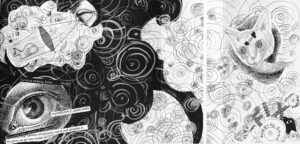
Graphic insert design for the zine accompanying the Art Mejking exhibition. MORFIKA, Gliwice 2025
What if this question is less of a “Q&A situation” and more of a map or game? For the purposes of this experiment, let’s assume we’ve been given this bizarre map—a game board, without an instruction manual—and we don’t know where to go, who’s playing with us, or even if it’s a real place. The individual elements of the question “What animal is that…” (see illustration) are signposts. We can hover and spin on subsequent loops, or jump further, following the emerging question until our curiosity is satisfied. Perhaps we’ll start building more elements and adding levels ourselves. At this point, we don’t know much more.
There are no easy explanations here, and as we embark on the path of exploration, we carefully observe and critically examine emerging threads.
We can set out alone or with our team. We can traverse the paths and twists, on three, two, or even four legs, at any time of day or night. It’s sometimes said that it’s worth “trusting the process,” but my advice is to maintain a modicum of skepticism so as not to be dragged down the rabbit hole by yourself or other players.
Try spinning the wheel and following your associations, and today, as an example, I invite you to follow the path I discovered.
In the beginning there was spinning
“Your head may not know where you’re going, but you’ll find out by acting.”
Nassim Taleb “Skin in the Game” (my own translation from Polish version)
Have you noticed that some hairless cat breeds have skin so wrinkled that it resembles a maze? As if they were wrinkling their inter-ear, externalized tangle of thoughts over the mystery of life. I wonder if that’s why they were called Sphynxes.
This image haunted me, and one day I decided to understand what it was like to live with a maze on one’s head. I unwrapped one of my failed attempts at creating a cat model (for a plaster mold) and set about transforming it. For hours, I twirled the animal sketch on a tall sculpture toque. I studied photos of small and large Sphynxes from various perspectives. An international group of Canadian, Russian, and British creatures watched my movements in silent anticipation from a board full of printed photographs.
And I would approach, only to retreat in dissatisfaction. I would retreat, only to immediately lunge across the table and quickly change the shape. I knelt under the cat, hovered over the cat, cut off and glued its head, lengthened its neck, carved out folds of skin and smoothed them out… For no apparent reason, but with great determination, I spun the cat around for days… until the cat spun me around.
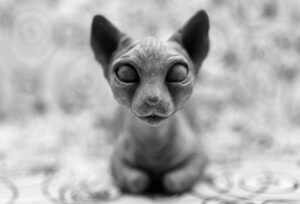
Fiks, clay sculpture. Morfika, Gliwice 2025
When I recall this work experience, I’m reminded of the words of Richard Sennett, a sociologist who studies, among other things, the work of human hands, that craftsmanship is the ability to organize obsessions. Such a pleasant, “self-comforting” phrase. Obsession, as Sennett understands it, is dedication and focused attention both on developing skills and on the quality of the work performed. It’s an impulse that drives the person undertaking a task to want to do it well.
The maze on the cat’s head certainly stirred some impulses within me. It’s pleasant to be momentarily tickled by the thought that this is, after all, nothing other than a truly “craft obsession,” but stopping at this point on the board of reflection sounds like a trap, and yet we’re only just entering the story.
Where does this strong need to create things come from and how do we deal with it?
Nassim Taleb, a thinker I sometimes find myself reading (and often constructively irritating), would probably try to answer with another question: “Maybe people want to do things—simply do them—because they feel it’s part of their identity?” He would add at this point that he believes craftspeople (in the sense of anyone who takes responsibility for their work) enter the game aware of the personal consequences of failure. In a passage about craftspeople in his book “Skin in the Game”, the author states, “Depriving people of their craft can be cruel. People want to have their souls in the game.”
Let’s assume the existence of this internal imperative. It’s a fascinating theory, one worth exploring for context. This takes us deeper into the game—metaphorically and literally.
Makers in the Game
At the end of April 2025, the Warsztat Miejski (a makerspace where I have been working and creating for several years) was invited to join a new city initiative as one of the local creative organizations. The Art Biennale was to be held in Gliwice for the first time.
The term “biennale” immediately evoked the grand scale and fresh artistic perspectives enjoyed in major global cities, so at first glance, the idea seemed bold… and highly abstract. This was especially true considering the scale of the event and its program—designed to engage a wide audience, showcasing a new, artistic face of the city. It promised to be quite a challenge. Until now, despite many interesting grassroots and city-based initiatives, I felt the world of contemporary art had been somewhat marginalized in Gliwice.
On the other hand, I thought, this was an opportunity for something new, and the biennale’s theme, “City of Art, Art in the City,” encourages us to seek connection in a shared living space. As it turned out, I wasn’t alone in this thinking, and the joint decision to join our City Workshop association was made very quickly.
We submitted a proposal for the “ART Mejking” initiative, which was met with enthusiastic response. That’s how we joined the program.
As the axis of our biennial narrative, we chose works by artists associated with our association. We wanted to weave them into our workspace – the carpentry shop, the photographic darkroom, the electrolab, the ceramics studio – alongside self-made tools that have often been used in the creation of various works. The Biennial’s slogan, “Art in the City, City in Art,” proved highly relevant in the context of the City Workshop’s long-standing activities, where, in the spirit of community self-organization, a space dedicated to literally “making things” is being developed. For the people of art, craft, and mejker hobbyists gathered in and around the association, these are not so much words as the actual realization of a dream and daily practice.
Most of the works presented at the Workshop during the week of the biennale were created thanks to the collaboration of people who care about maintaining and developing this shared space. What characterizes them is the fact that at the Workshop, people come together in action.
Another thread appears on my board.
What can be the values of meeting in a joint creative activity, and what can result from it for us and for the city?
What is this city that…
The culture of excess is largely the result of the characteristics of the online communication platform and the disappearance of the broadly understood review institution.
(quote translation by myself)
Prof. Tomasz Szlendak, Kultura nadmiaru w czasach niedomiaru,
Rolling after a rabbit on the Sphinx’s crazy board, I return to the recent past. In March 2024, I had the pleasure of leading my own reflective and creative workshop, “In Search of Idle Culture,” during the WUD Silesia Festival at the Academy of Fine Arts in Katowice. The festival bore the telling title “City of Knowledge,” and 2024 was a year of learning for Katowice, thanks to the prestigious distinction of being named the “European City of Science.”
As part of my workshop practice in the field of artistic research, I utilize original creative exercises, experiments, and provocations to stimulate the production of new knowledge. I usually design workshops in the spirit of so-called “explorations,” where we begin with the resources contributed by the group, and the result is a collaboratively created story or other product of collective creativity, which we then analyze in search of new meanings related to the chosen theme.
During the festival workshops, participants were tasked with building a “City of Culture.” This wasn’t about discussing culture in the city, but rather about the city that Culture would be if it were transformed into a large settlement unit. Starting from the thesis that contemporary culture is excessive, “accelerating,” and generally there’s too much of everything, this form of visualization of shared cultural experiences was intended to lead us to the working definition contained in the workshop title – “idle culture.”
The participants worked in three teams. The images that emerged from their work were characterized by several common features that may, at the very least, provoke reflection. Leaving aside the fact that in the models we experience “everything, everywhere, at once,” in each one one can observe segregation, or even fragmentation, of the city into closed thematic groups, intertwined only by a tangle of chaotic networks. In these colorful projects, brimming with ideas and opportunities offered by the city of Culture, there is a shadow of information overload, a sense of fatigue, lack of influence, and powerlessness. In one city, a tower was even built from which those who were “canceled from the city of Kultura” or who were victims of lynching can jump.

The City of Culture project, created by people participating in my workshop. WUD Silesia Festival, Academy of Fine Arts Katowice, 2024
One of the source materials I used to prepare the workshops was an article by Professor Tomasz Szlendak, analyzing contemporary confusion in the culture of excess. The author argues that there is a lack of selection tools that would help us recognize and navigate the contemporary deluge of content, words, objects, and images, and that social networks contribute, if not significantly influence, this widespread confusion and the multiplication of cultural offerings.
I think the third City of Culture project provides a good illustration of these observations.
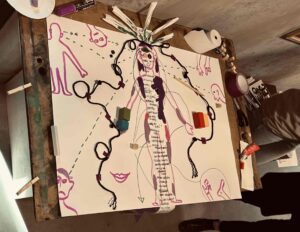
The City of Culture project, created by people participating in my workshop. WUD Silesia Festival, Academy of Fine Arts Katowice, 2024
In the third model, City of Culture takes the form of a human figure. The figure is filled with a cloud of thoughts—terms, ideas, and conflicting sentences that enter from above, through the top of the head, and accumulate along the spine throughout the body. Here, ecology intertwines with the culture of productivity, and the culture of collaboration with the culture of competition. There’s even room to note the conflict between Biedronka and Lidl and the profound philosophical questions of “to have or to be”?
In the broader perspective of the drawing, the figure attempts to build relationships with others through loops of networked connections. In this immediate environment, the figure seeks opportunities to connect, listens, looks, speaks, searches… while likely beginning to feel the atrophy of various elements of its body.
In this vision, City of Culture is a human-city seeking a way to integrate so many additional elements within its already small, highly complex, and delicate self-tissue. I imagine this man-city as such a wavering creature, taking uncertain steps and maneuvering in search of meaning and identity.
People-Cities are creatures who, perhaps at this very moment, most need to develop their own tools and mechanisms to support the selection and navigation of the overload of impressions. They seek support in directing their attention to what is, or may become, important.
The Embodied City
“This is the lesson: Great cities are like any other living things, being born and maturing and wearying and dying in their turn.”
N.K. Jemisin “City we became”
The alignment of our values with our surroundings can be demonstrated, for example, by the fact that we feel good in one place and uncomfortable in another. We find something there that we value, something that motivates us to be and act. Or it’s quite the opposite – a place causes us discomfort or a need to resist. Our values bring us closer to objects that convey similar values, or distance us from those that convey values at the opposite pole. The city can become such an object, such a place.
What if New York became a person?
In N.K. Jemisin’s fascinating novel “The City We Became,” New York becomes as many as six people. In this fantastical vision, cities, to truly be born and survive, require human avatars. These are individuals, chosen from among millions of others, who most fully reflect the multifaceted nature of the city.
The universe created by the author is a space where the great urban epicenters of multiculturalism are living, sentient beings, built on hundreds of years of history, tradition, multigenerational hopes, and influx of dreams. Within them, attitudes clash, conflicts and inequalities grow, violence spreads, but also art, activism, and engagement bubble up. However, these massive organisms slowly lose the strength to cope with external oppression and invasion. They must either be born in their own strength or be consumed. In the book, degenerative processes are represented by nonhuman representatives of cosmic chaos, in reality inspired by somewhat more real “monsters.” I recommend a conversation with the author.
The characters, who in an instant transform from residents of five New York boroughs into five different faces of the city, are, in my opinion, an incredible feat and a lever of imagination. Their relationships reveal dark sides, beliefs, fears, and resistances, but also a sense of wonder at the history of the place opens up, opening up space for social sensitivity and deepening attachment. This does not mean, however, that the embodiment of values and a shared mission have buried all conflicts, and that cooperation between the Bronx, Brooklyn, Manhattan, Queens, and Staten Island is a given.
The very embodiment of the city’s needs only opens up the potential for change.
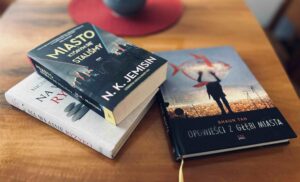
Suggestion of books cited in the text.
Looping back to the here and now
And here’s where we’ll seamlessly transition our agenda to the 2025 Gliwice Biennale.
The idea may have caught residents a bit by surprise, but not every change has to be an evolutionary process, right? Art was meant to fit into the broader #ZmieniamyGliwice campaign. I’ll just point out that I didn’t delve into the guidelines and I’m not always up-to-date with the city’s “sounds.” This time, however, the “morphic” part of me responded well to the word “Change.” I sharpened my senses, pricked my ears, and tried to take advantage of the proposed offerings and artistic experience, not only as a creator, but above all as a resident.
I won’t review the program or individual proposals. I’ll focus on the atmosphere. What proved most important to me was that the initiative made me feel a genuine desire to participate and immerse myself in the city with curiosity. I was drawn to get out of the house and see, feel, explore, and exchange observations with friends. It was great to wander through the exhibitions together, listen and strike up conversations, take photos in the interestingly arranged empty spaces, and advise newcomers on what to see, as well as gather recommendations myself. It’s been a long time since I’ve had so many unexpected exchanges with people I didn’t know before, in such a relaxed way. It was enough to pause for a moment in front of a light totem, join a queue, or watch kids working on an art installation by Academy of Fine Arts students, and a spark for conversation would ignite. And so it went for the entire summer week in July.
For me, it’s a completely different experience than attending a festival, or traveling and discovering new places. It’s experiencing a place so close to my daily life, suddenly transforming and becoming different than before. I realize that this initiative took months of preparation, involved enormous commitment from people and organizations, budgets, difficult decisions, and choices, but for me, as a result of all these processes, the city symbolically spoke to me and revealed its new face.
I felt good in the new incarnation of my city, and now, looking back after a few weeks, as the initial impression slowly fades, I think that if we were in the J.K. Nemesin realm, we would still find ourselves a long way from the birth of the city. We need the voices of other personalities, not just the colorful and luminous, but the barely sketched, character of the City of Art. A city’s identity cannot be built on the dream of a city center. But it’s undeniably an interesting beginning to a new story.
Which is the creature that…
“He showed up one evening, sneaking into their apartment through the window—just another lost soul looking for a bit of warmth and something to eat—and accepted the situation as if it had always been that way, completely uninterested in the past or the future, because in the cat world, such things don’t exist.”
(quote translation by me)
Shaun Tan “Tales from the Inner City”
One day, a cat goes missing in the city. Immediately, ads for those looking for a pet appear in various places. Different names for the pet, different addresses for the owners, but the same striped little fellow in the photo.
The cat wasn’t interested in artificial boundaries or divisions. He wandered wherever he wanted, and when the door was closed, he jumped in through the window. He was the best friend to anyone who took him in. The protagonists of Shaun Tan’s story find the cat’s body in their apartment. They recognize their cat from city ads and write down the addresses to inform everyone looking for a funeral. More and more guests arrive. Everyone bids farewell to their best cat in the world.
Sometimes so little, a small gesture, is enough to recognize what unites us. It may sound trite, but I’ll get through it somehow… because I truly want to believe that despite many unfavorable conditions, an all-encompassing culture, the entanglement of social media networks, and cosmic chaos, we can create the potential for change ourselves, rather than just wait for change to knock on our door.
And here we reach the point on the board where I decided to temporarily pause the game. I received a satisfying answer to the question posed in my work, “What is this animal that, carved from living rock, demands attention?”
Through the labyrinthine streets of the City of Art, following small posters, Art Mejking found his way to the City Workshop. Like many, he was among the large group visiting the Gliwice Biennale. He wandered around, chatted, viewed the exhibition and studios, and then said:
“I’d love to come back, it’s nice here… and you have a cat that dances.”

Fiks, Morfika 2025
The FIKS installation, presented during ART Mejking during the week of the Gliwice Biennale. Installation design and sculpture by Agata M. Nowak. MORFIKA, toque structure by Maciej Mastalerz, sound by therapeutic cat Gabor.